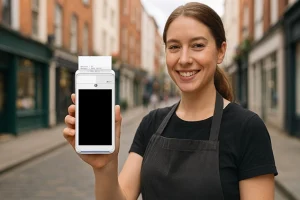

The ability to accept phone payments in Ireland gives any business a meaningful edge — taking card payments from customers who call to book, order, or settle an invoice without ever stepping through the door. For service businesses, tradespeople, healthcare providers, and hospitality operators, telephone payments fill a genuine gap between in-person card transactions and online checkouts.
Despite the growth of online payments, a significant number of Irish consumers still prefer to pay by phone, particularly older customers, those without smartphones, and anyone booking a service that does not lend itself to a self-serve online checkout. The Central Bank of Ireland confirms that card payments remain the dominant payment method in Ireland, and businesses that can accept them across every channel — including telephone — serve their customers more completely.
This guide covers everything an Irish business needs to know to accept phone payments legally, securely, and cost-effectively in 2026.
What Are Phone Payments and How Do They Work?
When a business accepts phone payments in Ireland, the transaction falls into a category known as MOTO — Mail Order Telephone Order. MOTO payments are a type of Card Not Present (CNP) transaction, meaning the customer’s physical card is not present at a terminal when the payment takes place.
The customer provides their card details verbally over the phone. The business operator enters those details manually into a virtual terminal — a secure, browser-based payment interface — and processes the transaction. The gateway communicates with the card network to authorise the payment, and the customer receives a receipt by email.
Because no PIN is entered and no card is physically verified, MOTO transactions carry a higher fraud risk than in-person payments. Card schemes price this into the interchange rate, which is why phone payment processing costs slightly more than face-to-face card transactions. Understanding this distinction upfront helps businesses budget accurately and choose the right provider.
What You Need to Accept Phone Payments Ireland
Setting up a telephone payment process for an Irish business requires three core components.
A Virtual Terminal
A virtual terminal is the primary tool businesses use to accept phone payments in Ireland. It is a secure web-based interface — accessed through a browser on a computer, tablet, or smartphone — where a member of staff manually enters the customer’s card details during a phone call. No physical card machine is required.
Most merchant services providers offer virtual terminal access as part of their payment package, either included in the monthly fee or available as an add-on.
A Merchant Account
A merchant account holds card payment funds between the point of sale and the transfer to your business bank account. Many providers bundle the merchant account with the virtual terminal and payment processing into a single package, simplifying the setup considerably for new businesses.
A Secure Process for Handling Card Data
Accepting phone payments in Ireland creates a responsibility around how card data is handled during and after the call. PCI DSS rules are clear: card details must never be written down, stored in a spreadsheet, or recorded on a call recording system. A secure, compliant process protects both the customer and the business.
Best Providers to Accept Phone Payments Ireland in 2026
New Payment Innovation (NPI)
New Payment Innovation offers Irish businesses a comprehensive payment solution that includes virtual terminal access for telephone payments alongside card machines and online payment gateway options. NPI’s local support team makes them a particularly strong choice for Irish businesses setting up MOTO payment capability for the first time.
The advantage of working with an Irish-based provider for telephone payment processing is direct access to a support team that understands Irish trading conditions and can resolve issues quickly. NPI offers transparent pricing, flexible contracts, and the ability to scale payment capabilities as the business grows.
easyPayments
easyPayments is an Irish payment provider that offers virtual terminal solutions well suited to businesses looking to accept phone payments in Ireland without complex technical setup. Their platform supports MOTO transactions with a clean, straightforward interface that staff can learn quickly, and their Irish support team is on hand when questions arise.
easyPayments suits businesses that want a dedicated Irish provider with a clear focus on straightforward, reliable payment processing. Their virtual terminal integrates with broader payment management tools, making it a practical choice for businesses that handle a regular volume of telephone orders alongside their other payment channels.
MOTO Payment Fees: What Irish Businesses Pay for Phone Transactions
Phone payments in Ireland cost slightly more to process than in-person card transactions. The higher interchange rate on Card Not Present transactions reflects the elevated fraud risk that card schemes associate with MOTO payments.
For Irish businesses in 2026, MOTO transaction fees typically range from 1.8% to 3.5% per transaction depending on the provider, the card type, and the monthly transaction volume. UK-issued and non-EEA cards processed over the phone attract the highest rates due to their exemption from EU interchange fee caps.
Monthly virtual terminal access fees range from zero — where the feature is bundled into a wider package — to approximately €20 to €30 per month for a standalone virtual terminal subscription. Businesses processing a meaningful volume of phone payments should request a direct quote from providers rather than relying on published rates.
PCI Compliance for Phone Payments: What Irish Businesses Must Do
PCI DSS compliance applies to every business that accepts phone payments in Ireland, and the rules around MOTO transactions carry specific obligations that go beyond those for in-person or online payments.
The most critical rule is straightforward: never record, write down, or store the customer’s full card number, CVV code, or PIN at any point during or after the call. If your business records phone calls for quality or training purposes, those recordings must not capture card details. The Payments Association of Ireland recommends that businesses pause call recordings during the card detail entry portion of a telephone payment.
In practice, most businesses manage this by asking the customer to read their card details while the operator enters them directly into the virtual terminal, confirming the transaction is complete before either party disconnects. The card details never touch paper or any recording system.
Confirm your PCI compliance level and obligations with your provider at the point of setup. Most reputable providers guide new merchants through this process as part of onboarding.
How to Handle Refunds and Disputes on Phone Payments
Phone payment refunds follow the same process as any other card transaction. The business processes the refund through the virtual terminal, referencing the original transaction, and the funds return to the customer’s card within three to five business days depending on the card issuer.
Chargebacks — where a customer disputes a transaction directly with their bank — carry a greater risk on MOTO payments than on in-person transactions, because the merchant cannot produce a signed receipt or a PIN entry record as evidence. The best protection against a chargeback on a phone payment is thorough record keeping: note the date, time, amount, and purpose of every telephone transaction, and send the customer an email receipt immediately after the call.
The Competition and Consumer Protection Commission provides guidance on merchant obligations around card payment disputes that every Irish business accepting phone payments should review.
Tips for Running a Smooth Telephone Payment Process
A few practical habits make telephone payment processing more efficient and reduce the risk of errors or disputes.
Train every staff member who takes telephone payments on the correct process before they handle a live call. A consistent approach across the team reduces mistakes and ensures PCI compliance rules are followed correctly every time.
Send a confirmation email to the customer immediately after every phone payment. Include the amount, the date, and a transaction reference. This gives the customer a record they can refer to if a query arises later and reduces the likelihood of a dispute.
Review your virtual terminal transaction log at the end of every trading day. Catching a processing error early is far simpler than resolving it after a customer has noticed a problem on their statement.
Accept Phone Payments Ireland With the Right Provider From the Start
The right setup to accept phone payments in Ireland combines a reliable virtual terminal, a transparent fee structure, and a provider whose support team you can reach when questions arise. For most small and medium Irish businesses, that means choosing a provider who offers virtual terminal access as part of a broader payment package rather than as a standalone product.
At Compayre, we help Irish businesses compare merchant services providers, virtual terminal options, and MOTO payment solutions side by side. Our free comparison tools cut through confusing fee structures so you find the right fit for your business without wading through sales material.
Ready to accept phone payments in Ireland and open your business to a wider range of customers? Call our team today on 01 265 4403 or visit compayre.ie for a free, no-obligation comparison.
This article is for informational purposes. MOTO payment fees and provider terms are subject to change. Always confirm current terms directly with your chosen payment provider before signing up.