
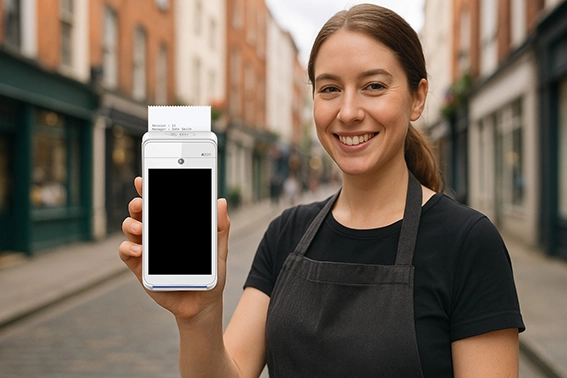
Finding the right card machine for restaurants Ireland means looking beyond a basic card reader. You need to think carefully about how your service actually runs. A restaurant environment places unique demands on payment hardware. Table service, split bills, tipping, and the pace of a busy service all create requirements that a standard retail terminal simply does not address.
Hospitality is one of the fastest-growing sectors for card payment adoption in Ireland. The Central Bank of Ireland reports that contactless payments now account for the majority of everyday transactions. As a result, restaurant customers increasingly expect to pay at the table, split a bill between the group, and add a tip without a complicated process at the end of their meal.
This guide covers what to look for, which features matter most in a hospitality setting, and how to choose a solution that keeps service smooth and costs manageable in 2026.
What Makes a Good Card Machine for Restaurants Ireland?
A card machine for restaurants Ireland needs to handle requirements that differ meaningfully from retail payment terminals. Therefore, understanding those requirements before comparing options saves time and avoids costly mistakes.
Table Service and Tipping
For restaurants offering table service, a portable handheld terminal that staff bring directly to the customer is the standard expectation in 2026. Customers no longer want to walk to a fixed terminal at the bar or counter to pay. Furthermore, pay-at-table functionality reduces awkward end-of-meal moments and speeds up table turnover.
Tipping is equally important. The card machine your restaurant uses must make it easy for customers to add a tip at the point of payment. Look for terminals that prompt the customer to add a percentage or a custom amount before the transaction completes. As a result, a smooth tipping process increases the likelihood of customers tipping at all.
Split Bills and EPOS Integration
Groups dining together frequently want to split the bill between multiple cards. A restaurant card machine that handles split payments efficiently — by amount, by item, or by equal division — keeps the end-of-meal process professional and avoids unnecessary delays.
In addition, a card machine that integrates directly with your EPOS system removes the need for manual entry of amounts at the terminal. The payment amount transfers automatically from the till, the customer pays, and the transaction reconciles in the system without double-handling. This reduces errors considerably during busy service.
Connectivity and Battery Life
A restaurant card machine must maintain a reliable connection throughout service. During a Saturday night rush, a terminal that drops connection creates real problems. For this reason, look for terminals with dual connectivity — both Wi-Fi and 4G mobile data — so the device switches automatically if the broadband drops.
Portable handheld terminals also need to last a full service shift. A lunch and dinner service can run eight to ten hours. Always confirm the battery performance of any portable terminal under regular use before committing.
Types of Card Machine for Restaurants Ireland
Restaurants in Ireland use several different terminal configurations. The right type depends on the service style and the size of the operation.
Handheld Portable Terminals
The most popular choice for full-service restaurants. Staff carry the terminal to the table, customers pay and tip on the spot, and the device returns to a charging dock between uses. Modern handheld terminals are slim, fast, and built specifically for hospitality environments.
Countertop Terminals
Suited to counter-service restaurants, cafés, and takeaways where customers pay at a fixed point of sale. Countertop terminals connect via broadband and offer fast, reliable processing at a lower hardware cost than portable systems. However, they do not suit table service environments.
Integrated EPOS Terminal Systems
A full point-of-sale system where the card terminal and the restaurant management software operate together on the same platform. Orders move from table to kitchen automatically, bills generate without manual input, and the payment terminal pulls the correct amount directly from the system. This integration level suits larger restaurants and multi-outlet hospitality businesses.
Mobile Card Readers
Compact readers that connect to a smartphone or tablet via Bluetooth. These suit smaller cafés, food trucks, and pop-up dining events. They also work well for new restaurant businesses that want a low-cost entry into card payments before investing in a full terminal system.
Key Features to Compare When Choosing a Restaurant Card Machine
Beyond core payment capability, several features distinguish a strong restaurant card machine from a basic retail terminal. Here is what to prioritise.
Tip Prompting
The terminal should prompt the customer to add a tip as a standard part of the payment flow. This feature directly affects tipping rates and is a non-negotiable for most full-service restaurants.
Partial Payments and Split Bills
The ability to process multiple partial payments against a single bill is essential for group dining. Always confirm this functionality works smoothly before committing to any terminal system.
Receipt Options
Printed receipts, email receipts, and SMS receipts serve different customer preferences. A terminal that offers all three handles every situation without friction.
Multi-Currency Support
Restaurants in tourist-heavy locations frequently serve international guests. As a result, a terminal that accepts foreign cards and supports Dynamic Currency Conversion gives those customers a familiar payment experience.
Reporting and Analytics
End-of-service reporting showing total transactions, average spend, and peak hours helps managers make informed decisions about staffing and menu pricing.
Understanding Restaurant Card Machine Fees in Ireland
Card machine fees for restaurants in Ireland follow the same basic structure as other merchant services. However, there are some hospitality-specific considerations worth understanding.
Transaction fees for in-person restaurant payments typically range from 1.5% to 2.5%. The exact rate depends on the provider, the card type, and monthly transaction volume. Larger operations, in particular, should negotiate directly with providers rather than accepting standard published rates.
Monthly terminal rental fees vary between providers and terminal types. Generally speaking, portable handheld systems cost more to rent than countertop terminals, reflecting the more sophisticated hardware involved. In addition, integration fees may apply when connecting a card terminal to a third-party EPOS system. Some providers include this support in their package. Others charge a one-off setup fee.
The Competition and Consumer Protection Commission advises Irish businesses to request a complete fee schedule from any provider — including monthly charges, minimum transaction fees, and early termination costs — before signing a contract.
PCI Compliance and Security for Restaurant Card Payments
Every restaurant in Ireland that accepts card payments must meet PCI DSS security standards. In practice, most restaurants achieve compliance through a certified payment terminal and provider. The technical security sits on the provider’s infrastructure, so the merchant’s day-to-day responsibilities are straightforward.
Operationally, staff must keep terminals physically secure, report any suspected tampering immediately, and never write down or store customer card details. The Payments Association of Ireland provides PCI compliance guidance for hospitality businesses. Restaurant owners should review this guidance as part of their onboarding process with any new provider.
Choosing the Right Card Machine for Your Restaurant
The best card machine for restaurants Ireland operators should choose in 2026 depends on the type of service, the size of the operation, and the integration requirements of the existing till system.
A small café with counter service needs something different from a forty-cover restaurant offering full table service. Similarly, a food truck has different priorities again. Mapping your specific service model to the features and costs of available solutions gives you a clear basis for comparing providers. This approach is far more effective than simply choosing the cheapest hardware available.
For full-service restaurants, a portable handheld terminal with tipping, split billing, and EPOS integration is the standard requirement. For counter-service operations, a reliable countertop terminal with fast processing is the priority.
Compare Restaurant Card Machine Options With Compayre
At Compayre, we help Irish hospitality businesses compare card machine options, merchant services providers, and fee structures side by side. Our free comparison tools cut through the complexity so restaurant owners find the right payment solution for their service style and budget.
Ready to find the best card machine for your restaurant? Call our team today on 01 265 4403 or visit compayre.ie for a free, no-obligation comparison.